Prof. Yi Shi and Prof. Yun Li at the School of Electronic Science and Engineering, Nanjing University, together with Assistant Professor Qijing Wang from the School of Integrated Circuits, Nanjing University, in collaboration with Prof. Henning Sirringhaus (University of Cambridge, UK) and Prof. Jingsi Qiao (Beijing Institute of Technology), published a research article in Nature Electronics entitled “Metallic charge transport in conjugated molecular bilayers”.
Metallic transport refers to a charge-transport behavior in which a material’s electrical conductivity increases as temperature decreases. This phenomenon is typically observed only in inorganic semiconductors such as single-crystal silicon. Due to weak intermolecular interactions and strong dynamic structural disorder, achieving metallic charge transport over a wide temperature range in organic semiconductors has long been considered highly challenging.
To address this challenge, the team leveraged a new approach that enhances conjugated coupling between molecular layers in ultrathin single crystals, and proposed and validated a novel, ultra-two-dimensional charge-transport mechanism: a “van der Waals-bridged molecular bilayer transport network.” This mechanism not only markedly strengthens interlayer charge tunneling and orbital coupling, but also suppresses vibration-induced dynamic disorder by increasing structural rigidity, and effectively reduces the influence of Coulomb interactions among charge carriers on transport. In undoped organic semiconductor materials, the team observed, for the first time, metallic transport over an ultrawide temperature range down to 8 K, with conductivity as high as 245 S cm-1, and Hall mobility exceeding 100 cm2 V-1 s-1. This result not only significantly surpasses the previously reported performance limits of organic field-effect transistors, but also brings the conductivity level closer to that of inorganic semiconductors such as heavily doped silicon and wide-bandgap GaAs. The finding, at a fundamental physical level, challenges the conventional view that weak van der Waals interactions inevitably lead to low-temperature carrier localization, and breaks the perceived performance barrier that organic materials cannot rival inorganic materials, offering new directions for both fundamental research and applications of high-performance organic electronic materials.
Furthermore, by controllably introducing defects, the team clearly observed, for the first time in an organic semiconductor system, a disorder-driven metal-insulator transition and its quantum critical scaling behavior. Such results are extremely rare in the field of organic semiconductors. This work successfully extends the physics of quantum phase transitions—previously studied mainly in classical inorganic semiconductors and strongly correlated electron systems—into organic systems, and provides an ideal model platform for investigating organic Mott-Anderson systems.
This research was jointly carried out by Nanjing University, the University of Cambridge, Renmin University of China, Beijing Institute of Technology, and other institutions. The first authors are Dr. Kua-Kua Lu, Prof. Yun Li, Assistant Professor Qijing Wang, and Dr. Linlu Wu. The corresponding authors are Prof. Yun Li, Assistant Professor Qijing Wang, Prof. Jingsi Qiao, Academician Yi Shi, and Prof. Henning Sirringhaus. Key support was also provided by Dr. Xinglong Ren (University of Cambridge), Prof. Songlin Li, Prof. Xinran Wang, Prof. Chunfeng Zhang, Prof. Chaosheng Li (Nanjing University), Prof. Wei Ji (Renmin University of China), Prof. Yeliang Wang and Prof. Xu Wu (Beijing Institute of Technology), Prof. Gang Chen (ShanghaiTech University), Associate Professor Liqi Zhou (Shanghai University), Associate Professor Sai Jiang (Changzhou University), and Prof. Peng Wang (University of Warwick, UK). This work was supported by the National Key R&D Program, the National Natural Science Foundation of China, the Natural Science Foundation of Jiangsu Province, and other programs.
Original article link: //www.nature.com/articles/s41928-025-01553-5
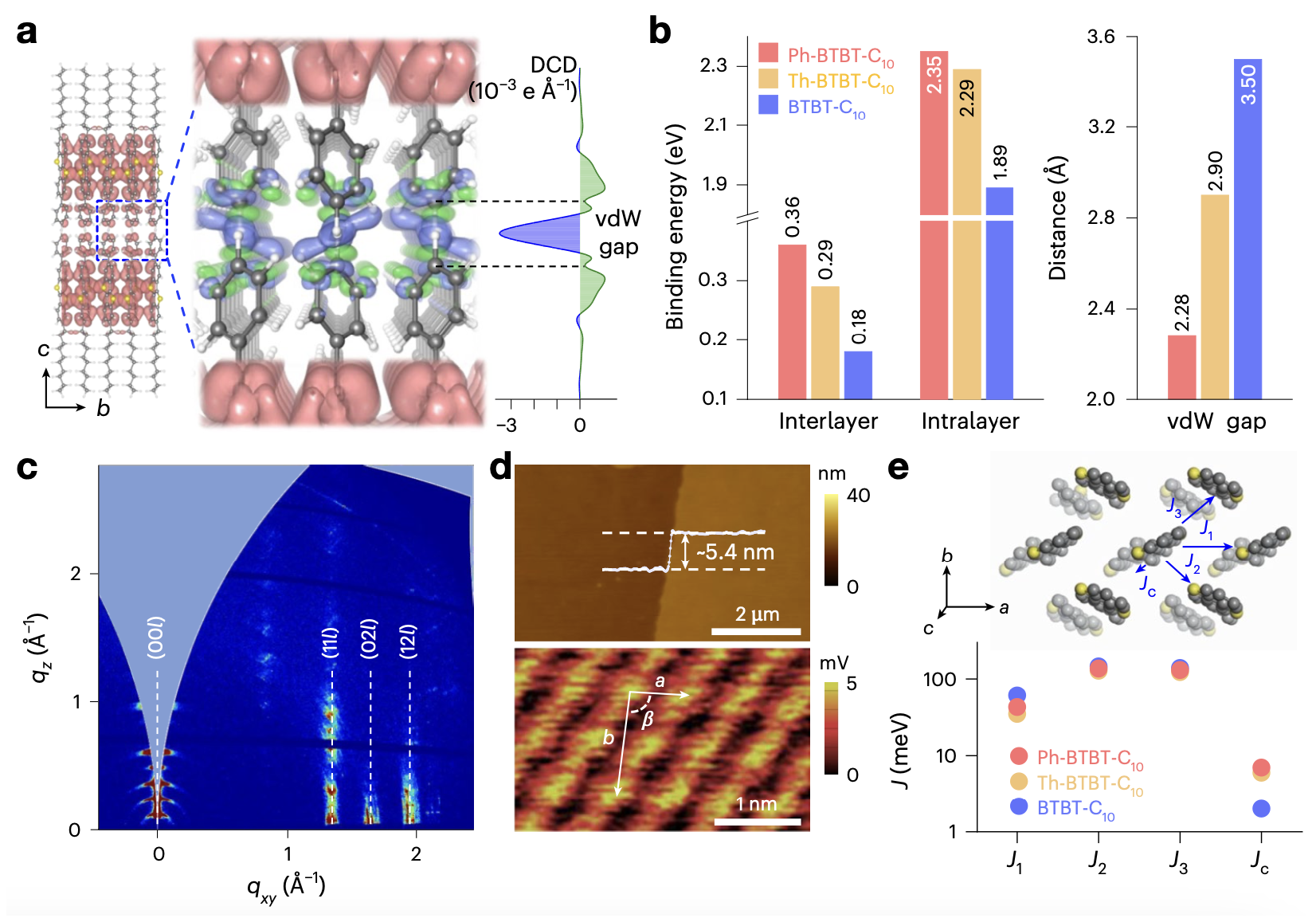
Figure 1. A “van der Waals-bridged molecular bilayer transport network” based on the interlayer conjugated phenyl-ring pairs of Ph-BTBT-C10. (a) Schematic of the HTH structure of Ph-BTBT-C10. (b) Interlayer and intralayer binding energies and van der Waals gaps of Ph-BTBT-C10, Th-BTBT-C10, and BTBT-C10. (c) GIWAXS characterization of Ph-BTBT-C10 crystals. (d) AFM and high-resolution AFM (HRAFM) characterization of Ph-BTBT-C10 crystals. (e) Schematic of molecular packing in Ph-BTBT-C10, and transfer integrals of Ph-BTBT-C10, Th-BTBT-C10, and BTBT-C10.
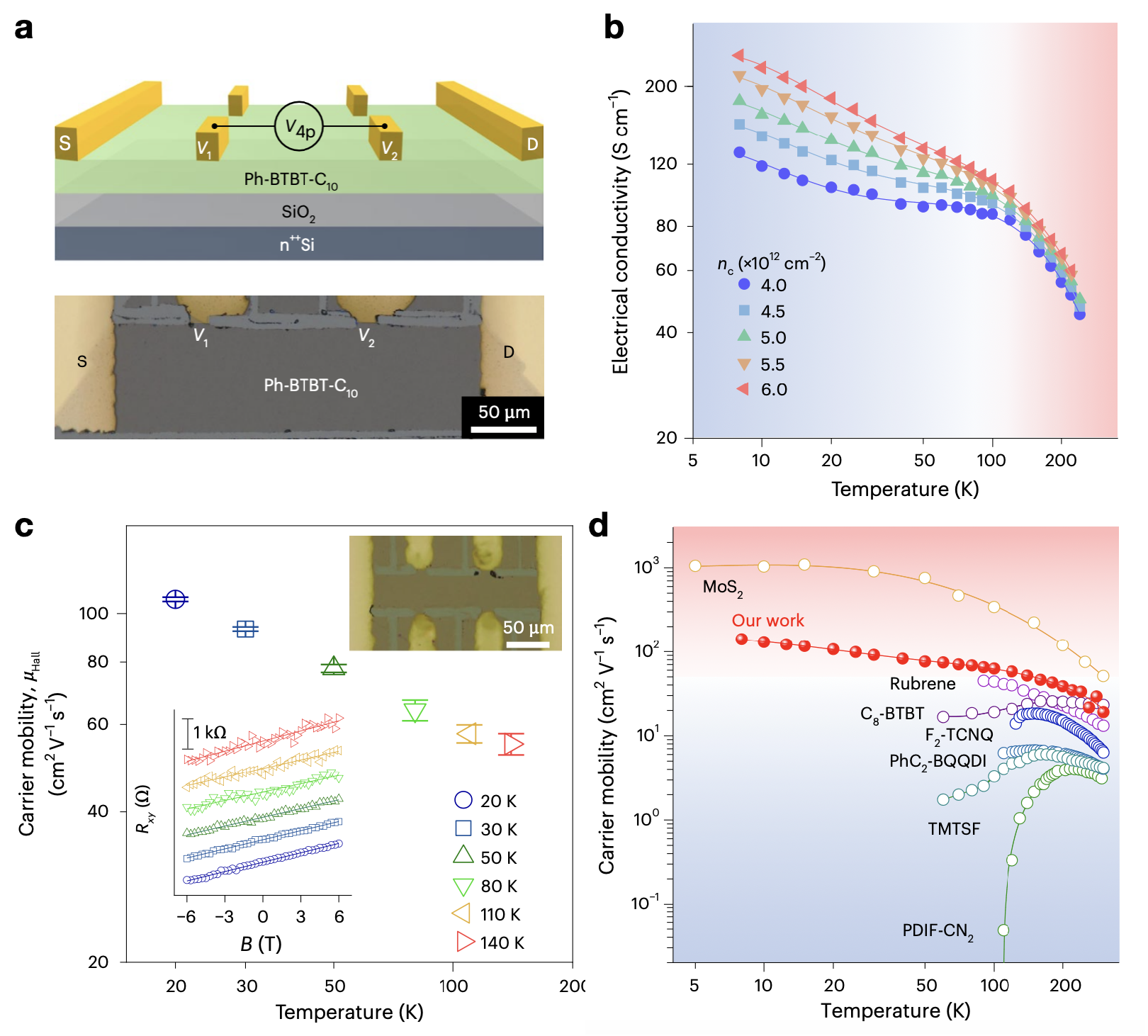
Figure 2. Metallic charge transport over an ultrawide temperature range. (a) Schematic of the four-probe device structure and the corresponding optical micrograph. (b) Conductivity versus temperature at different carrier concentrations. (c) Hall mobility versus temperature. (d) Statistics of high-mobility organic single-crystal semiconductors.
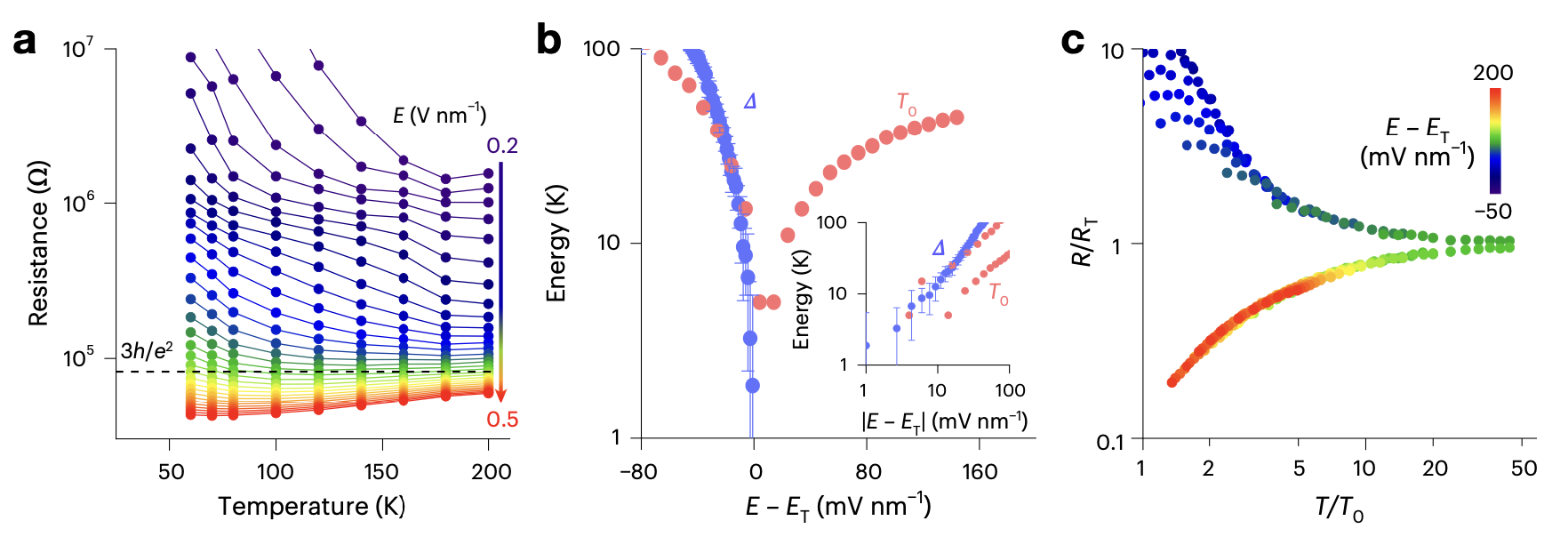
Figure 3. Disorder-driven metal-insulator transition and quantum critical scaling behavior. (a) Sheet resistance versus temperature under different electric fields. (b) Activation gap Δ and temperature scaling parameter T0 as the electric field E approaches the critical field ET. (c) Resistance-versus-temperature curves near the metal-insulator transition.